Monday, 6 June 2016

Facebook CEO Hacked on Twitter, Pinterest


Facebook Founder and CEO, Mark Zuckerberg, temporarily lost control of both his Twitter and Pinterest accounts some hours ago, after a hacker broke into both, defacing the pages.

According to the hackers, OurMine,  Zuckerberg’s vulnerability  was in re-using passwords. The team said that they found his details in a database of 117 million passwords hacked from social network LinkedIn in 2012, from there, they were able to gain access to his Twitter account, where they tweeted “you were in Linkedin Database … DM for proof”, and his Pinterest account, the name of which they changed to read “Hacked By OurMine Team”. They also alleged to have broken into his Instagram account, but Facebook refutes this saying, “No Facebook systems or accounts were accessed.”

The notorious hackers stated that they hacked into the Facebook's CEO account to test his security. It is so disappointing that despite being a tech savvy CEO of the biggest social media site in the world, Zuckerberg seems to have the same security weaknesses as a lot of us.

Before the hack, Zuckerberg last tweet was traced back to 2012 which still remained intact. Twitter swiftly suspended Zuckerberg's finkd account for a while, but put it up without the offending tweets from the hackers. Pinterest did likewise with his zuck account.


If Zuckerberg’s account could be hacked, don’t even want to imagine how extremely easy it will be for this notorious team and it likes to penetrate into the our accounts. Cyber security is KEY and should be taken SERIOULY.

Friday, 3 June 2016

Concretus – The Wireless Bluetooth Speaker Made From Concrete


The Concretus is a concrete speaker slab that opts for a utilitarian design that is constructed using solid rock. The speaker boats a minimalistic aesthetic that is unique to each unit thanks to the individual way the concrete sets with each speaker.

While concrete might seem like an unlikely and heavy element to use to construct a sound system, the Concretus provides an ample sound quality. This is perhaps due to the air bubbles that form within the concrete as it sets, leading the sound to magnify throughout the material when solid.

The concrete is cut into a slanted rectangle with the audio elements fitted directly into the thick block. The simplistic design leads the sound system to be adaptable to any home decor.


Hongqi L5 - China’s Most Expensive Car at N160m Costs more than a Rolls Royce


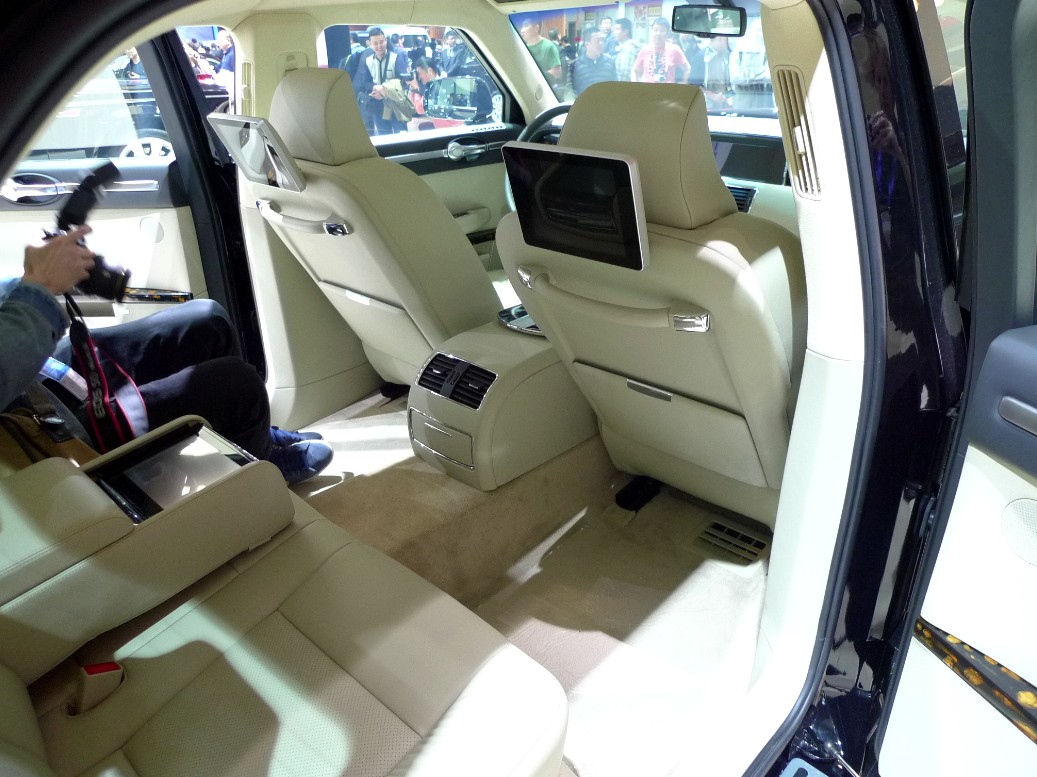
Talk of auto superfluity and tech, then you have Chinese luxury car, Hongqi L5.  At $800,000(N160m) this sleek ride, targeted at multibillionaires is equipped with a 6.0 liter V-12 engine and produces 402 hp. and 405 lb/ft. of torque. The car also features intelligent 4-wheel-drive technology and an adjustable hydro-pneumatic suspension.


The interior sports celadon-jade door handles, hand-carved wood inlays, perforated leather upholstery and a tablet centre console. The rear compartment is equipped with 1.1 metres of leg room, beige carpets, rear-seat entertainment system with television,   Bose sound system and  6-disc CD changer.


The retro modern sedan car from the company, Hongqi (Red flag), China’s oldest automaker known for their mammoth limousines and parade cars, was bought by Wang Zhonghua , Nanjing based car enthusiast. The car will be ready in three months.

Rio 2016 Olympics: Visa Unveils NFC Mobile Payment Ring for Athletes


Electronic card company  and exclusive payment provider of the Olympic Games, Visa  has invented a water-resistant, battery-free ring tagged "Visa payment ring", that will allow athletes make payments during the forthcoming Rio 2016 Olympic   Games  in August.  The ring is NFC-enabled, allowing athletes to make purchases by simply tapping their ring at any NFC-capable payment terminal.
The first payment wearable ring backed by a Visa account will be given to all Team Visa athletes in a group of 45 Olympic hopefuls from around the world who embody Visa’s values of acceptance, partnership and innovation.

“Visa’s first payment ring puts smart payment technology right on the hands of our athletes for convenient and easy payments and strategic partnerships at Visa. This ring is the latest example of how Visa is continuously innovating to deliver on its goal of universal acceptance at the games and across the world,” said Jim McCarthy, Executive Vice President of Innovation, Visa.
He added that athletes and fans will also be able to use their Visa accounts. From booking and planning their trip using Visa Checkout or making purchases at the games on their mobile phone, both experiences are first-time offerings for Rio 2016, enabling athletes and fans to swipe, tap, dip or click to pay during their Olympic experience.
Chris Dean, Senior Director, Visa Innovation and Strategic Partnerships   said the idea for a ring came as result of Visa's conversations with athletes, who were looking for a simple payments device without the stress of charging and something that could survive in water.  “With that in mind, the Visa device is made of a light, shiny ceramic and embedded with an antenna. It is water-resistant to a depth of 50 metres and does not need a battery; instead, it pulls in power from a point-of-sale machine when it is placed over it”.
Demonstrating in a press conference, he showcased how the new device works just like the smartphone or smartwatch to make payments, with a user simply placing the ring above a point-of-sale machine. He added that the ring will be connected to a prepaid Visa account, which can be reloaded online. When lost or stolen, the ring's account can be changed, the same way Visa closes out a stolen credit card number.
Commenting on the Visa Ring, Missy Franklin, four-time Olympic gold medalist and Team Visa athlete said the athletes will appreciate the innovation , as it will  be great going for a competition without having to carry a wallet or card when you need to transact.


Thursday, 2 June 2016

India Overtakes US as the Second Largest Internet User


Last year a report by Mobile Association of India (IAMAI) and market research IMRB claimed that the total number of Internet users in the India will reach 402 million by December 2015, of which 351 million will go online daily. The figure which meant India will surpass U.S on total web users.
A new report “Internet Trends Report 2016” by Mary Meeker, an Analyst at venture capital firm, Kleiner Perkins Caufied & Byers   reveals that India has surpassed the US as the world’s second-largest internet market,  as internet user growth remains consistent led by acceleration in India, but still behind China.
The report states that, India has low internet penetration — nearly 30 percent — among the population and also low cost of smartphones have resulted in slowdown of smartphone user and shipment growth. The average cost of a smartphone in India is $158(N31,000) which is among the lowest in the world. India has been branded as a mobile-only market as over 300 million of its estimated 400 million internet users access the Internet only through mobile devices.
It further explained that, just as internet advertising continues to grow, so also does ad-blocking, pushing the envelope on development of more innovative ad formats. “Internet will need to be overhauled as adblockers were installed on 420 million smartphones, growing at 94 percent year-on-year. This growth is driven by users in India, China and Indonesia.”


Why Visafone was sold to MTN- Jim Ovia


In January, MTN Nigeria completed the acquisition of Visafone from Zenith Bank , in a move to improve the quality of broadband services for its subscribers.

At Digital Africa conference and exhibition 2016 organised by Digital Africa Global Consult in Abuja, Mr. Jim Ovia, Chairman, Zenith Bank attributed the lack of efficient broadband required for speedy telecommunications service as one of the reasons Visafone was sold to MTN, South African telecommunications firm.

The acquisition of the CDMA network was in support of the National Broadband Plan, for the benefit of Nigerians. The purchase which sought to leverage resources for service enhancement, was also reflective of the company’s concerted efforts to deepen the growth and roll out of broadband services across the country, he said.

Ovia affirmed that without adequate technology infrastructure to power constant connectivity, Internet of Things (IoTs) would be difficult to achieve. “We have a lot of devices some of which will be dead equipment. Connectivity is very important and without it, internet of things or internet of everything cannot take place. I would not say that connectivity is the most important thing, but it is extremely very important. In some of this connectivity you need it by way of broadband or by way of fibre optics to give you the broadband or may be a wireless. Or may be the spectrum of between 700-800 MGHz that gives you the broadband speed that you need today, and so you can now understand why Visafone eventually sold its network to MTN.”

According to him, the reason there were so many complaints was because of the resource availability that Visafone had, which had to do with the broadband. Policymakers must ensure that Nigeria is not left behind in the technological development of the future, he advised.

Wiso: Your Personal Emergency Whistle


The Wiso is a Bluetooth-connected smart whistle designed to help you call for safety when you are being assaulted. Using a corresponding app, it o automatically texts, calls, or emails designated contacts with the victim's GPS coordinates.


>>Requirements
•iPhone or Android with Wiso app installed and configured for most features to function.
•Both Bluetooth and location should be enabled in the smartphone setting, and the app should have permission to use location data. Otherwise contacts will not know your location when Wiso is activated.
•A working mobile internet connection in order for the Wiso app to notification contacts.

>>Compatibility
•Wiso works on Apple iOS and Android devices with Bluetooth 4.0 (Bluetooth Low Energy).
•Supported Apple Devices using iOS 7 or higher: iPhone 6S, 6S Plus, 6, 6 Plus, 5, 5C, 5S, 4S
•Supported Android Devices using 4.4 or higher (KitKat or Lollipop): Samsung Galaxy S4, S5, S6,     HTC One, Butterfly S, LG Nexus 4, Nexus 5, Sony Xperia E3

>>Privacy Concerns
•You control when and what data is shared. Wiso delivers location info to your emergency contacts ONLY when you choose to.
•Web links with users' locations are automatically disabled after a set of time.
•2048-bit Secure Sockets Layer (SSL) is used for all communications between app and server.

>>User Interface
•You log in through existing social network accounts, including: Twitter, Google+, Facebook, Yahoo! Japan and Mixi.
•When an emergency occurs, your pre-selected contacts are notified through SMS/email/phone call, along with a web link with the user’s location history that can be opened by all modern web browsers.

>>Reliability
•Multiple service providers for sending SMS/email in the most timely and reliable manner
•Wiso is designed to work in an uncertain environment, it copes with unreliable network condition and sends the most up-to-date information to the server when possible. The server is equally designed to cope with a client with bad network access.
•When the server detects that no emergency contacts has opened the included location tracking web link, it automatically resends SMS/email with the link to the contacts several times to improve the chance of the message being seen.

>>Battery
•During standby,the app and WISO minimises communication to conserve phone and  device battery.

•In a sustained emergency, WISO adjusts its operation according to the phone’s battery level. When the battery is low, WISO app updates the phone’s location at a reduced rate, ensuring sustained operation of the phone and the app.